Huruma Special Unit is now on facebook! Like us and you will get updates on your newsfeed about the progress of the school David is working at. just go to www.facebook.com/HurumaSpecialUnit and click like!
Karibu facebook!
Thursday, August 2, 2012

Saturday, July 28, 2012
Chachachachanges…..
I know, I know. We are terrible at blogging. Sorry. We’ll try
harder. I promise. I also promise that we won’t start every blog with an apology. A few changes have gone down over the
last few weeks so I thought I would get everyone in the loop. Here’s the
abbreviated version: New principal, new ministry opportunity, AND new dog!
New Principal
After a month off of school, I have returned to meet our “new”
principal or as Tanzanian say “Head Teacher”. The day before we got out for
vacation I showed up at the school to find all of the teachers sitting in the
hallway chatting. When I asked what they were doing, they said “Planning
Grace’s going away party!” I must say I was pretty taken aback since the day
before I had been talking to Grace (the mkuu)about events coming up in August and she failed to
mention that she would be leaving in two days. Long story short, the next day
we said “good bye” to Grace, headed out for school vacation and month later we
have a “new” mkuu. I say “new” because the replacement principal is actually a
teacher who has been promoted.
Her name is
Sister Oliva and she is awesome. She just doesn’t know it yet. Last Monday when
I asked her what she thought about her new job she said “I don’t know how to do
anything.” I told her that I would help her as much as I can and she seemed
very pleased. The truth is, she is very organized and professional and I think
with some cheering on, she is going to be great. The best thing is I have had a
lot of time to build a relationship with her in the classroom and she seems to
respect my ideas, so with God’s help, maybe we can start fixing some of the
broken systems in the school that have been tugging on my heart like shaming
and hitting. I am very optimistic that positive change is coming to Butimba.
Please pray for Sister Oliva that she finds the confidence and time (oh yeah, I
forgot to mention that she still has a full classroom full of kids to teach on
top of her new job) to bring changes of compassion to our preschool.
New Ministry Opportunity
Over the two months that I observed in the two general ed
classrooms at Butimba, I felt myself being more and more drawn to new special
education classroom at our school. I started visiting the classroom during my
break between morning and afternoon classes and found that I really enjoyed
working with the students. I was also very impressed with their teacher,
Salome. Salome used to teach at David’s school, Huruma, but when presented with
the chance to start a new special ed program in an area that really needed it,
she dropped everything and moved out to Butimba.
The more time I spent in Salome’s classroom, the more I
realized how much help she could use.
I discovered that she had three big roadblocks. 1) No money. After
chatting with Salome I found out that the parish priest who had promised to
fund the program, doesn’t actually have the money he thought he would so Salome
is essentially working for free.
2) No community support. It also came out that the parish community as a
whole isn’t thrilled about the special education program. 3) No teacher’s assistant. On a normal
day Salome only has 5 to 6 students in her classroom but the students range in
age from 7 to 16 and have disabilities of varying levels of severity. It is
nearly impossible for her to accommodate all of their unique needs on her own.
The first two issues are huge and will take some time and
prayers, but the third issue is something that I feel like I can tackle. While
I will still be assisting Sister Oliva and the other teachers in the general
education classroom 2 full days a week, I have volunteered myself to assist
Salome 3 mornings a week. My hope is that my presence in her classroom will
lift her spirits and make her feel more supported while also showing the parish
priest and community as a whole that I think the special education program in
invaluable.
So far, I have spent 2 weeks in Salome’s classroom and I
love it. This week we only had 4 kids so it has been really nice to get some
one on one time with each student. Some of the kids have pretty profound
disabilities so at this point Salome and I are somewhat at a loss for what to
teach them, but as for now we are just trying to keep smiles on their faces and
I think we are doing a pretty good job.
New Dog

Wednesday, June 13, 2012
Inclusion is coming!
 |
| Mwalimu Godfrey helps Yohana get ready for the "potato sack" race as Joseph from Huruma and other kids from Pasiansi primary school look on. |
 |
| Mwalimu Agnes jokes with some of the kids from the primary school |
Check out this video of some field games Mwalimu Godfrey and Mwalimu Agnes set up with all the kids together.
Monday, May 21, 2012
Where have we been?

1. Finished language school

2. Went on a trip of a lifetime
The day after language school we hopped on a plane to Arusha to meet up with Caitlin's family for an incredible safari in honor of her late Aunt Sue. As many of you know, Caitlin's aunt, who passed away last November, owned a travel company that specializes in safaris. Over many years she became very close friends with a Tanzanian man named Willy Chambulo who owns Kibo Safaris. In gratitude for Sue's friendship and mentorship Willy invited all of Sue's children and siblings to come to Tanzania and stay in several of his amazing camps and safari lodges, all expenses paid.
We felt very blessed to be a part of this incredible trip. The highlights were driving into the middle the great wildebeast migration, sneaking up on 10 sleeping lions, spending the night in canvas tents in the middle of the Serengeti where lions and hyeanas could be heard right outside and getting the chance to show our family some of the reasons why we love this country (oh yeah and let's be honest, gin and tonics, swimming pools and the bathtub at Lake Masek Luxary Tented Camp). The most important and touching event of the trip was spreading Sue's ashes near a lake full of hippos. It was a very moving experience to watch her be returned to the land that she loved so much. We were honored to be a part of this trip are overwhelmed with gratitude for Willy and more than anything the legacy and memories of Sue.
3. Started our jobs
As soon as we returned from our safari we jumped right into work. David immediately began testing his Swahili skills, getting to know the teachers and students at Huruma. Within days of starting he was already being asked to help write IEPs and figure out how to pay for the school bus. The bus situation has been a big challenge for the school because many of the parents cannot afford to pay their students share for the bus. This means that almost half of the students in the school have been staying home. David and the other teachers are wracking their brains for fundraising ideas to find a sustainable way for the school to pay for the bus. All in all the teachers are trying their hardest and many students face great challenges daily, yet it is a very happy place and David enjoys working there very much.
Caitlin has had a much slower start at the Butimba chekachea. She has spent the last few weeks observing in the two classrooms, struggling through tea time Swahili conversations with teachers who want to know everything about Europe and mzungu hair (they haven't quite figured out that all white people don't live in Europe)and trying to sneak in some phonetic awareness songs and games when possible with the students. The kids are extremely eager to learn and Caitlin finds herself completely surrounded by them whenever she sits down to help a student. She will admit that she still gets completly giddy when she walks in the classroom and all of her students stop what they are doing, stand up and say "Good morning teacher Katie! How are you? We are fine, teacher Katie!"
In her weeks of observing Caitlin has noticed several areas where she feels the teachers can improve their use of class time, discipline techniques and engagment of the students in curriculum. She is bursting at the seams with ideas but is patiently waiting to share while she practices her Swahili, learns more about how schools in Tanzania work and builds relationships with her teachers and mkuu (head teacher).
4. We moved into our new house
We know that the suspense has been killing all of you waiting to hear which house we chose. (If any of you are remember our post from so long ago.) We chose...wait for it...the Mabatini house!
 |
| Caitlin cookin' up something 'licious |
Our first night was rough. The mosquito net was too small for our bed, we had to staple fabric over the window to serve as curtains and Caitlin came down with a crazy head cold. The biggest problem was that we didn't have enough gas in our stove to boil water so we had nothing to drink and more importantly we couldn't make tea for our new guard Julius as he took on his first overnight shift on our porch. To say that moving into a new home in Tanzania is a different experience than in the states is definitely an understatement.
All in all we are much more settled now. At this point we have a bed, a stove, a refridgerator, a table, two couches and a whole lot of empty space. Soon we will be ready to entertain guests with our many spacious rooms so get your tickets booked!
That's some of the latest for life here- we'd love to hear from you if we haven't already. Shoot us an email if you'd like to know more or have an idea for how to get involved at rosser@mklm.org. Thanks for reading!
 |
| View from our front porch. |
Sunday, March 25, 2012
House of Compassion- Kigera Village
 |
| Father Mike Basano M.M., Liz Mach MKLM and watoto wengine (other children) |
How do we describe the experience we just had? Lord, help me.
This month a group of Americans have come over to Tanzania
with a trip called Friends Across Borders (FAB) in order to see what MKLM, the
Maryknoll Sisters, Fathers and Brothers are doing here. Today the group got to travel to the
House of Compassion at Kigera village, about an hour from Mkoko Language School
and we were invited to come along.
House of Compassion is a compound of about 70 people, all
abandoned for one reason or another by society, even by their own
families. Here men and women with
mental illnesses, orphans, people with HIV/ AIDS and other disabling factors
that have left them unable to care for themselves in Tanzanian society, come
together and live in community. While the rest of the society has told them
that they are throw away people who are an unwanted burden, House of Compassion
welcomes them with open arms, understanding and love.
To briefly describe the site, it was started in 1992 by a
Tanzanian parish priest, Father Godfrey Bisako, who responded to the desperate
needs he was seeing of homeless and abandoned people on the streets of Musoma
and Mwanza. He had started a
similar house closer to Musoma in the 1980’s, but the house at Kigera is far
bigger. About two to two and a
half football fields in size, the buildings were designed to provide security
and a sense of community by surrounding the perimeter of the area, forming a
rectangle, with the exception of a cross shaped chapel and a dispensary within
their shape. On one side are the
rooms of an Italian Marist brother, Father Mike Basano and the other homeless
men. Adjacent is a long
guest/dining room, another dining room and the kitchen, and adjacent to that
are the rooms for women and children.
 |
| Bougainvillea |
Still, describing the setting in no way conveys the experience
of walking through this campus full of ducks, chickens, orange and magenta
bougainvillea trees, people sitting on the ground with dejected faces that
easily melted into smiles, people coming up to us, greeting us with that
unique, warm Tanzanian hospitality, small children grabbing our hands and pant
legs, babies being passed from arms to arms, people with obvious physical and
mental disabilities wandering aimlessly, dancing and laughing. All of this was
happening in one of the poorest countries in the world, where running water and
electricity are not even a guaranteed luxury. Personally, I don’t think we have
ever seen a place so desperate.

Yet, the day was filled with hope. Without any fanfare and a with bouncing run, Father Mike
Bassano, a Maryknoll priest, came running to greet us as we pulled in this
morning. Fresh, excited and eyes
wide open, Father Mike toured us around the “village”, scooping up random children
like a young grandfather and telling us their unimaginably heart breaking
stories as he naturally bounced them on his hip or lovingly pinched their
cheeks. As we toured, a severely
mentally disabled man interrupted Father Mike’s explanations several times, but
the second generation Italian didn’t miss a beat and began joking with the man.
It was clear the man thought he and Father Mike were equals, something he
clearly learned from Father Mike who frequently is heard saying “We’re all in
this together”.
 Father Mike’s phrase is exemplified in many ways at the
House of Compassion. Even though all of the compound’s residents have burdens
of their own, they all manage to take care of one another. We saw babies being
passed around between adults and older children, young children pushing
wheelchairs of their elders and teenage girls helping with the cooking and
cleaning. No one is forgotten about and everyone gets what he or she needs.
Clothes are old and worn, the food is simple and the bedrooms are humble, but
it appears that everyone’s needs are provided for.
Father Mike’s phrase is exemplified in many ways at the
House of Compassion. Even though all of the compound’s residents have burdens
of their own, they all manage to take care of one another. We saw babies being
passed around between adults and older children, young children pushing
wheelchairs of their elders and teenage girls helping with the cooking and
cleaning. No one is forgotten about and everyone gets what he or she needs.
Clothes are old and worn, the food is simple and the bedrooms are humble, but
it appears that everyone’s needs are provided for. 
Mass was one of the most moving experiences we have had in a
long time. We sat in awe next to a seventy-five
year old Tanzanian women, surrounded by people the world has more or less
forgotten. Watching a boy called John Eybel (named after the priest who found
his pregnant mother, who would later abandon her son, wandering the streets), diligently
helping Fr. Mike on the alter we knew that here God had come in such a gentle,
emphatic, loving way to tell these people, “I know your pain, I too suffered
abandonment, loss and physical torture.
And I am here with you now.
You are not forgotten.” The
beautiful, tender harmony of the people’s singing and solemn kneeling on hard
planks testified that possibly nowhere in the world was God’s love appreciated
more, than here.
 After lunch, we took a trip to the lake to see the wind
powered water pump and the meager farm.
Moses, one of the many children who from the beginning had latched on to
our hands everywhere we went, kept saying to Caitlin, “Twende kaburini!“ (Let’s
go to the graveyard!). It seemed like such an odd place for a four year old to
insist on visiting, but when Father Mike explained that he often liked to take
walks there with the children to remember the people, which their community had
loved and lost, it made sense. It was so beautiful to see Moses and the other
children walking happily among the dirt mound graves as if they were visiting
old friends. The graveyard wasn’t a scary sad place for them, it was a familiar
place filled with people they had been told stories about and people who they
had loved and who had loved them. Truly death had lost it’s sting.
After lunch, we took a trip to the lake to see the wind
powered water pump and the meager farm.
Moses, one of the many children who from the beginning had latched on to
our hands everywhere we went, kept saying to Caitlin, “Twende kaburini!“ (Let’s
go to the graveyard!). It seemed like such an odd place for a four year old to
insist on visiting, but when Father Mike explained that he often liked to take
walks there with the children to remember the people, which their community had
loved and lost, it made sense. It was so beautiful to see Moses and the other
children walking happily among the dirt mound graves as if they were visiting
old friends. The graveyard wasn’t a scary sad place for them, it was a familiar
place filled with people they had been told stories about and people who they
had loved and who had loved them. Truly death had lost it’s sting.
In the future, on desperate days when we ask, where is God,
or what is he doing in this world, hopefully we will think back on what we saw
today and remember.

To see a video of the House of Compassion and Father Mike's work made by someone else, visit http://youtu.be/VhP7C9mUxxI
Sunday, March 18, 2012
How We Spent our Language School Vacation . . .
After a whirlwind week in Mwanza, we have returned to Musoma
to finish out our last month of language school. While some students spent the
week pumzika (relax)-ing, we spent our week away from school taking care of
business. This included
getting licenses, visiting work sites, shopping for rental houses, practicing
driving and finishing our tax return.
Driver’s License:
 Pretty much the same process is involved in getting a
Tanzanian driver’s license as in the U.S., except, we had to go back and forth
to the police station two blocks away three times, make a deposit at the bank
and come back the next day to pick the license up. All the same, when we got our licenses they looked
pretty fancy, even fancier than our Washington licenses in David’s opinion. They have some anti-counterfeiting
translucent holograms on them that look cool, two pictures that would be pretty
hard to copy and a graphic explanation of what class driver’s license we were
given. The best part was that the
TRA (Tanzanian Revenue Authority) trusted the Department of Motor Vehicles in
WA and didn’t make us retest- even though here in Tanzania they drive on the
opposite side of the road. We also
give props to the TRA for their graphic organizer, which explained the process
that one needs to go through to renew and obtain a license. It may not have
been an accurate representation of what our process looked like in reality, but
at least they are trying.
Pretty much the same process is involved in getting a
Tanzanian driver’s license as in the U.S., except, we had to go back and forth
to the police station two blocks away three times, make a deposit at the bank
and come back the next day to pick the license up. All the same, when we got our licenses they looked
pretty fancy, even fancier than our Washington licenses in David’s opinion. They have some anti-counterfeiting
translucent holograms on them that look cool, two pictures that would be pretty
hard to copy and a graphic explanation of what class driver’s license we were
given. The best part was that the
TRA (Tanzanian Revenue Authority) trusted the Department of Motor Vehicles in
WA and didn’t make us retest- even though here in Tanzania they drive on the
opposite side of the road. We also
give props to the TRA for their graphic organizer, which explained the process
that one needs to go through to renew and obtain a license. It may not have
been an accurate representation of what our process looked like in reality, but
at least they are trying.
Houses
We looked at a lot of houses last week, some which fit all
of our criteria, some that didn’t fit any and some that we could never afford
with our humble Maryknoll stipend. The house hunting experience was quite an
adventure as there is no official real estate infrastructure in Mwanza. Our
hunt consisted of driving around Mwanza, picking up random acquaintances of
other MKLMers and then driving with them to various rental houses they had
heard about through word of mouth. In the end, we have narrowed our search down to two houses. We are pretty torn. Here are the
contenders:
 |
House B is in a hillside neighborhood about 10 minutes
outside of downtown Mwanza called Mabatini. It is about an half hour drive to
the nearest Maryknoll Lay Missioner, but about 2 minute walk to a Maryknoll
Parish run by a couple of really nice American Maryknoll Brothers and Priests.
The parish is very active and appears to be growing quickly which would provide
us the opportunity to take part in the parish community and possibly participate
in the development of outreach programs. The house is much bigger than we need
and has a sort of awkward layout, but it has been well maintained as it used to
be the Maryknoll Fathers and Brothers house before they built a rectory at
their church. The house sits on a grassy shaded lot with two other houses that
are both owned by the former police chief, who lives in one of the homes part
time. The other home is lived in by a current police officer. We aren’t sure
exactly how long our commutes to work might be, but we think David’s commute
might look more like a 40-minute drive and Caitlin’s commute by dalladalla we
think might be closer to 30 minutes. One other thing we really liked about the
house is that is also very close to an outdoor market and shops and there is a
soccer field right beside it.

Opinions anyone???
Caitlin’s Visit
to Butimba
On Tuesday and Wednesday I spent two full days in my future
classrooms. The teachers and students alike seemed very excited about me being
there and I had to explain several times that I was only visiting and wouldn’t
be starting full time until April. Even by the time I left, I’m not sure that
anyone really understood.
The teachers I will be working with are very enthusiastic
and appear very excited to have an American in their presence. They asked me
several questions about America and told me several times that they wanted me
to help them learn English. They were also very excited at my attempts to speak
Swahili. It was a little bit awkward spending the entire day in the classrooms
as a visitor because the teachers really wanted to put all of their energy into
treating me like a guest. They were constantly coming to check on me, bring me
tea, uji, homemade donuts and chapatti.
At one point one of my teachers even sent one of her 5 year olds out to
the street to buy me a fresh deep- fried rice donut. It was hard to find the balance of being polite and
accepting all of their generosity and wanting to stand up and yell “FORGET
ABOUT ME, TEACH THE KIDS!”
The children were also very enthusiastic, but amazingly
quiet and focused in the classroom. That sat quietly on their mats; truly only
spoke when spoken to and ALL of them participated in every activity. It was like nothing I had ever seen in
America. The kids were so eager to learn and please their teachers. I think it is going to take me a very
long time to get used to that.
The teachers use a lot of really great Montessori methods
that allow for a lot of student participation. They also use a lot more English than I expected. They give most
directions in English which in turn require an English response from the
students- like when the teacher says, “Stand up,” the students stand up and say
in unison “We are standing up” or when she says “Sit down” the students all sit
down and say, “We are sitting on our mats.” It is really quite adorable when
they speak English because they have somewhat British accents so they don’t
pronounce their “r”s . They say things like “sweata,” “teacha,” “ motha,” and “fatha”.
I think I could listen to them
speak English in unison all day with a smile on my face.
Overall, the teachers are doing some really great things,
but there is definitely a lot of room for improvement. I was literally bursting
with suggestions by the end of my two days, but held back and bit my tongue knowing
that I still have a great deal to learn about culture and education in
Tanzania. (Teacher friends, I have a million other details to tell you about
the classroom. If you are interested, send me and e-mail because I would love
to tell you more about it.)
David’s Visit to Huruma
David’s visit to Huruma went just as well, although none of
his teachers asked him to teach them English- go figure.. He said that the students appear to be learning and happy and
the teachers seem to take great pride in the accomplishments of their students.
It gives us a lot of joy to know that students with disabilities who once were
not allowed to go to school and simply remained at home all day are now being
educated in a flourishing school. The school is fortunate to have many teachers
and aides, however, in time there certainly will be some ways to help them
better their practice, and hopefully, integrate kids at other local public
schools with the students at Huruma.
While David visited, though, someone had broken the spigot
for the outside water, so he and one of the other teachers set to impromptu maintenance
and made a makeshift stop. Later
in the week George Otte and David replaced the makeshift stop with a cap and
placed a new spigot inside the small house where the water tank is.
Saturday, February 25, 2012
A Day in Our Life at Language School
We are humbled and honored to have heard some clamor for more info on what goes on for us here in Africa. While there hasn't been much quite ready for Hollywood just yet, we are learning the language at a clipping pace. Here are a couple of brief snapshots of what the daily life of a student at Mkoko Language School usually looks like.
7:00 Wake up!! (much better than the standard at HPS, if I may be so bold). Mass is celebrated at 7, so if we are to go, we usually arise about 15 minutes before seven, but, hey, who's counting?
7:30 Breakfast. A light meal here, consisting of fruit, toast and an egg to order if one desires. Fruits range from mango, papaya, pineapple, soursop, bananas, watermelon and lately oranges- all fresh from here on the grounds.
 |
| Hamming it up between class! |
8:30 Mazungumzo Class
During our Mazungumzo class our teacher reads aloud a conversation between three fictional characters, Damas, Paskalia and Padri Robert (the American Missionary Priest who wants to know everything about everything) concerning topics such as land ownership laws, dowries and circumcision. The teacher also explains what all of the new vocabulary words mean and then they helps cement the sentences into our heads by making us repeat them outloud. Then, usually, the next day we come in, recite the conversation from the previous day and then start the process over again.
9:20 Hadithi Class
 |
| Damasi, Paskalia, na Padri Robert |
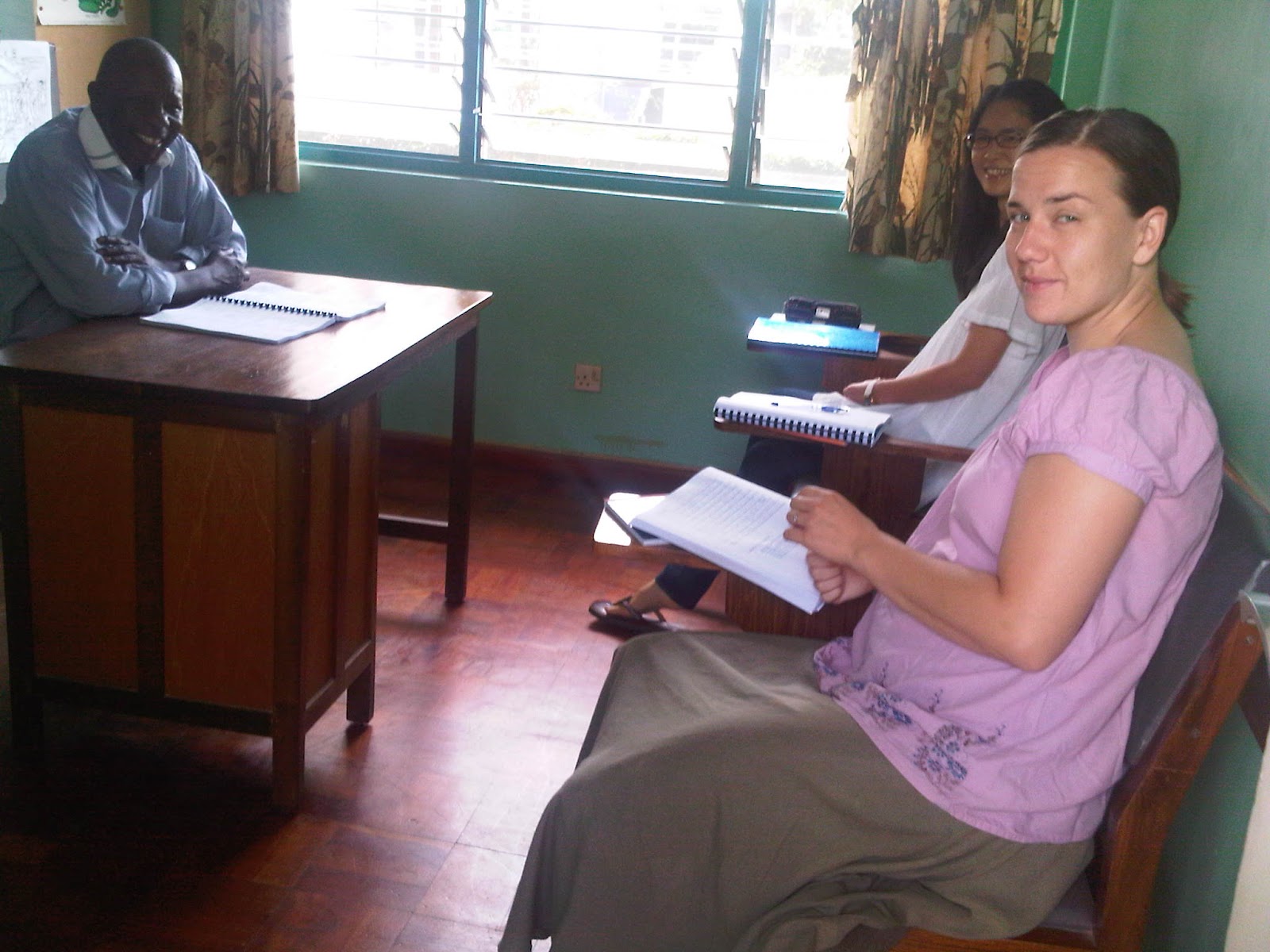 |
| A typical classroom with Mwalimu Joakim, Kim and Caitlin |
 |
| Walimu wa Mkoko: L to R, Dismas, Sylvester and Joakim |
10:10 Sarufi Class
Depending on who your teacher is, Sarufi or grammar class can either be an easy or more difficult class. If you have an experienced teacher light bulbs are turning on right and left and you can almost hear things clicking, but some teachers are still learning the ins and outs of explaining grammar in English and it takes a little cooperation to discern exactly how a new part of speech works. All in all, each teacher tries their best and we come to an understanding. During this class we have been introduced to all 12 of the noun classes and all the different tenses one could imagine, even some that don't exist in English.
10:50 Chai
If you ask the average 3rd grader what their favorite subject in school is, most will likely respond with "recess." Call me a 3rd grader, I think my favorite subject is Chai or tea time. Each day after our first 3 classes all of the students and teachers gather in the dining room to drink tea or coffee and eat homemade donuts, scones and occassionally left over pizza. While the refreshments are a bonus, what I honestly like the most about Chai time is that the teachers sit down with us like peers and chat with us. Sometimes we practice our Swahili and sometimes we just practice our English by talking about whatever burning questions the teachers have about America- everything from ice fishing to hip hop music.
11:05 Mazoezi
12:30-2 Lunch and Nap. True to the warmer countries, a siesta is strictly enforced and appreciated (well, not really enforced, but nothing else is going on and it is terribly hot so the later is indeed true).

 2:00-2:45 Language Lab. All over again we listen to tapes of the teachers reading the Mazungumzo, Hadithi and Mazoezi as we follow along trying to anticipate the correct infixes and subject prefixes, or even the correct vocab word! The machines are vintage Sony, but they serve their purpose faithfully unless the power is out. Then, shida kubwa!
All in all, we are very grateful for our teachers and the patience and knowledge they give as we seek to learn Swahili!!
Subscribe to:
Posts (Atom)